
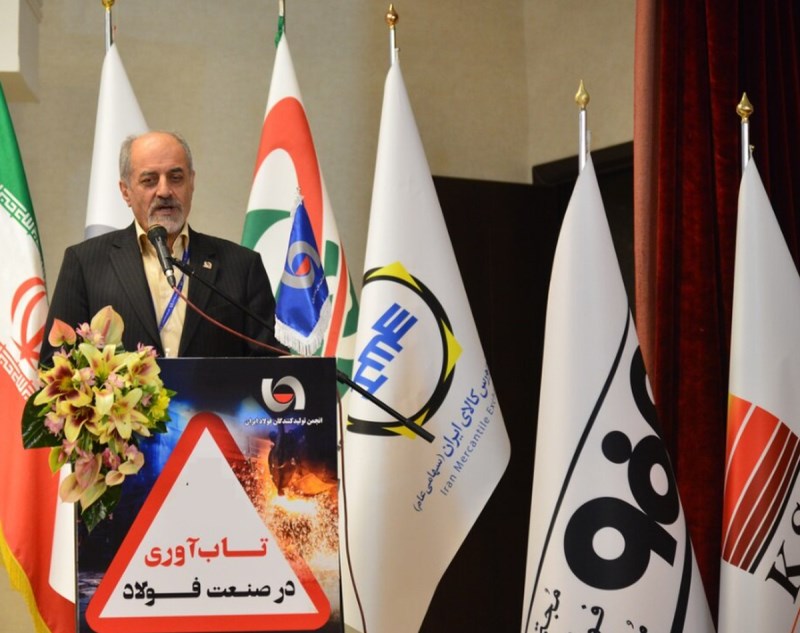
According to the Trade, Mining, and Steel News Agency, Bahram Sabohani, the head of the Iranian Steel Producers Association, emphasizing that energy is like “oxygen” for the survival of the steel industry, warned that the continuation of electricity and gas restrictions not only disrupts production but also poses a serious threat to employment, exports, transportation, mines, and downstream industries. He stated at the “Sustainability of Production in the Steel Industry with a Focus on Energy Challenges” event that considering the production structure in Iran, where more than 90% of it is carried out in direct reduction units and electric arc furnaces, electricity and gas play a decisive role. Sabohani, referring to the driving dimensions of this industry, noted that each job in the steel industry leads to the creation of more than 20 indirect jobs, and any disruption in energy supply affects the chain from mines to automotive and home appliance industries.
The head of the Iranian Steel Producers Association, describing the dire situation of companies’ profit margins, announced that based on Codal data and financial statements, the profit margin of this industry has reached around 6%, which is a worrying figure for an industry with this volume of investment and risk, and some units have even entered the loss-making zone. He compared the cost trend from 2019 to the present, noting that while the selling price of steel has increased by about 600%, the electricity rate has seen a staggering 3500% growth. Sabohani emphasized that in addition to the base rate, the addition of excess items such as regulatory differences, power plant fuel costs, energy differences, Article 16 costs, and transit costs has caused the final electricity bill to be 30 to 40% higher than the base rate in some cases.
Regarding electricity imbalance, Sabohani stated that the total electricity consumption of the steel chain from mine to final product is less than 6,000 megawatts, but during periods of restrictions, this amount has decreased to less than 3,000 megawatts. He added, providing specialized statistics: “The total electricity consumption of this industry is approximately 5,310 megawatts, of which 3,684 megawatts (equivalent to 69%) is provided by the steel units themselves from their self-sufficient capacities.” He also criticized unstable pricing policies and uncertainty in energy supply, stating that this situation has created mistrust among investors, as even investors who have spent money to build power plants face uncertainty and are forced to buy from the energy exchange during crises.
In the energy market analysis section, the head of the Iranian Steel Producers Association referred to the unfair competition between the steel and petrochemical industries in the energy exchange, saying that due to the lower share of electricity in the production cost of petrochemical products, this industry can buy electricity at higher prices and absorbs the supplied electricity. He proposed setting a price cap and separating the days of electricity supply for different industries to solve this problem. He also criticized