
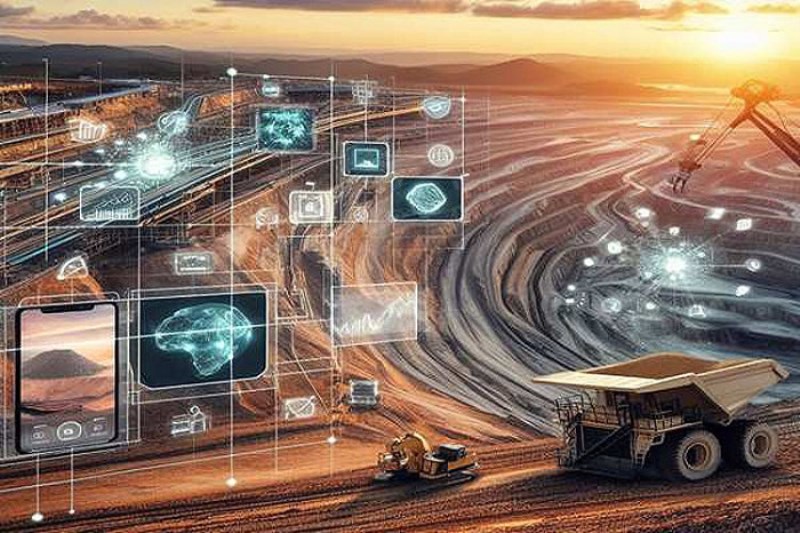
According to Tejarat, Madan va Foolad: The global mining industry is entering a new stage of digital transformation—a stage in which artificial intelligence, autonomous robots, the Internet of Things, and digital twins are moving into the heart of mining operational and management processes.
In recent years, the mining industry has faced challenges such as declining ore grades, rising extraction costs, stricter environmental requirements, a shortage of skilled labor, and growing demand for critical minerals. Under such conditions, mining companies are compelled to make broader use of digital technologies in order to maintain their competitiveness. A report published by the Indian Chamber of Commerce and Deloitte shows that, in the future, technology will not be a secondary advantage, but rather a necessity for increasing the productivity, safety, and sustainability of mining operations.
Moving Beyond Mining 4.0
Over the past decade, Mining 4.0 has brought major transformation to mines through the introduction of the Internet of Things, smart sensors, equipment automation, drones, and remote-control systems. However, the Mining 5 report emphasizes that, in many cases, the data generated still remains in separate systems, and decision-making is carried out in a siloed manner. The fifth generation of mining has emerged to address this very disconnect—a model aimed at connecting the different components of a mine and using integrated data to support managerial decisions.
In the fifth generation of mining, artificial intelligence can simultaneously analyze data related to geology, machinery performance, energy consumption, weather conditions, transportation, and environmental indicators, and suggest various operational scenarios. However, the final decision will still rest with managers and specialists, while artificial intelligence will play a decision-support role.
The digital twin is another key technology of this generation: a virtual version of the mine that receives information on equipment, reserves, extraction, processing, transportation, and energy consumption. Before implementing a decision, managers can examine its consequences in a simulated environment—a capability that helps reduce risk and prevent costly decisions.
Technology in the Service of Safety and Sustainability
One of the important applications of smart technologies is improving safety. Systems equipped with artificial intelligence, wearable sensors, and machinery data can identify signs of operator fatigue, equipment defects, the likelihood of collapse, and other hazards before they occur. This approach shifts safety management from reacting after an incident to preventing risks.
At the same time, reducing water and energy consumption, lowering carbon emissions, recycling mining waste, using renewable energies, and environmental rehabilitation are becoming an important part of mine management. Smart technologies also make it possible to monitor resource consumption and pollutant emissions in real time.
Future Investment in Technology
Australia, Canada, the United States, Chile, China, and the Nordic countries are among the countries that have made extensive investments in smart mining. Autonomous trucks, remote-control centers, 5G networks, robotics, electric machinery, and automated underground mines are part of these countries’ path toward digitalizing the mining industry.
According to the Mining 5 report, by 2030, mining companies’ investments will increasingly move toward artificial intelligence, digital platforms, integrated management systems, autonomous equipment, energy management, and carbon-emission reduction technologies.
Meanwhile, the success of the fifth generation of mining does not depend solely on purchasing technology; it also requires the development of digital infrastructure, workforce training, and organizational readiness. For mining countries, including Iran, this transformation can provide a foundation for increasing productivity, improving safety, and strengthening the competitiveness of the mining industry in global markets.