
This article was prepared and edited by Dr. Bararzadeh, a specialized energy consultant at SIGMAS.
Decarbonization of the steel industry is no longer a distant vision or merely a long-term policy goal; it has become one of the main axes of technological transformation in the steel production chain. As the industry gradually moves from the conventional blast furnace – converter route to hydrogen-based direct reduction and electric arc furnace melting, not only does the process chemistry change, but the design, selection, and operation requirements of refractory linings also undergo fundamental changes. This transformation has confronted the refractory industry with a set of new challenges, many of which still require study, operational monitoring, and the development of technological solutions.
Hydrogen Steel Production Route and Its Difference from Conventional Processes
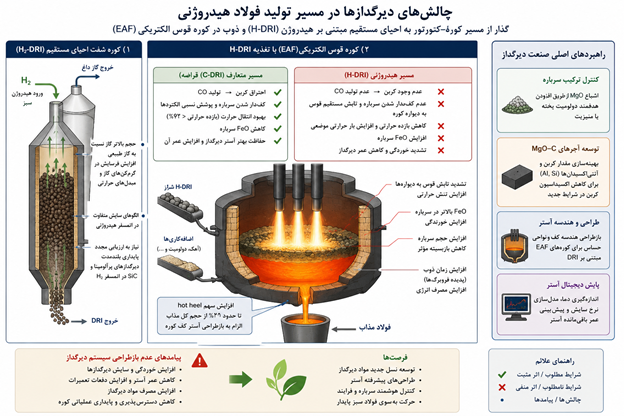
In the hydrogen-based direct reduction process, iron ore is reduced in a solid state, and in the ultimate horizon, green hydrogen will replace natural gas as the reducing agent. The product of this process is sponge iron or DRI, which is then melted in an electric arc furnace and converted to steel. At first glance, this route seems like a clean, efficient, and carbon-reduction-compliant solution; however, from the perspective of refractory technology, this change in route creates entirely different operating conditions. The most significant difference between the H-DRI-based electric arc furnace and conventional routes based on scrap or carbon-containing DRI is the elimination or drastic reduction of carbon from the process feed.
The Role of Carbon in Process Stability and Refractory Protection
In the classic operation of an electric arc furnace using carbon-containing DRI, the carbon in the feed plays a multifaceted role in process stability. The combustion and reaction of carbon in the molten bath produce carbon monoxide bubbles. These bubbles make the slag foamy, causing the electrodes to be partially covered by the slag layer. The formation of foamy slag, in addition to improving heat transfer and increasing thermal efficiency, plays a crucial protective role against the direct radiation of the arc to the furnace walls. Under such conditions, thermal efficiency can reach over 93%. At the same time, the presence of carbon helps reduce the FeO content in the slag, thereby reducing the chemical attack intensity of the slag on the refractory lining.
Consequences of Carbon Elimination in the H-DRI Route
In the H-DRI route, this key mechanism is largely eliminated. The absence of carbon means the elimination of part of the chemical energy input to the process. On the other hand, the production of carbon monoxide and, consequently, the formation of foamy slag are severely limited. In the absence of this protective layer, the electric arc radiates more intensely to the walls and sensitive areas of the furnace body. The direct consequence of this situation is an increase in local thermal load, intensification of thermal shocks, and an increase in the wear rate of the refractory lining at critical points in the furnace.
Impact of Increased FeO on Slag and Refractory
The reduction or elimination of carbon also creates important chemical consequences for the slag and refractory system. In conditions where there is not enough carbon in the molten bath, the remaining iron oxides will not have an effective reduction possibility, and a larger portion of FeO will enter the slag phase. The increase in FeO in the slag is undesirable from two perspectives. First, it leads to increased iron losses and reduced metal yield of the process. Second, it increases the corrosiveness of the slag towards MgO and MgO-C based refractories. Therefore, the hydrogen steel production route, although attractive from the perspective of reducing carbon dioxide emissions, creates a more aggressive and complex environment for refractories.
Chemical Erosion of MgO-C Refractories
Chemical erosion is one of the most significant mechanisms of refractory degradation in electric arc furnaces. The MgO in the refractory dissolves to some extent in the molten slag, and its solubility depends on the chemical composition of the slag, bath temperature, and especially the amount of FeO. The MgO saturation level in the slag usually ranges from 6 to 14%, but the increase in FeO changes this balance to the detriment of the refractory. As a result, the dissolution of MgO increases, and the wear of MgO-C bricks occurs at a faster rate. This issue can lead to a reduction in the refractory’s service life, increased maintenance frequencies, higher refractory consumption, and reduced operational availability of the furnace.
Increase in Slag Volume with DRI Consumption
In addition, DRI feedstock typically contains oxide impurities that, upon entering the furnace, increase the amount of process slag. Compared to scrap-based operation, the widespread use of DRI can significantly increase the slag volume. An increase in slag volume, especially if basicity is not properly controlled, creates more corrosive conditions for the refractory. A decrease in effective slag basicity or changes in the CaO, MgO, SiO2, and FeO ratios can disrupt the thermodynamic equilibrium of the slag and increase the dissolution rate of refractory phases.
Challenge of Incomplete Melting and Formation of Froberg
Another significant challenge in melting DRI is the formation of solid or unmelted clusters in the molten bath, sometimes referred to as “froberg.” At high DRI charging rates, part of the feed may not melt completely and uniformly, remaining as solid clusters in the bath. This phenomenon leads to longer melting times, increased energy consumption, and thermal instability in the furnace. From a refractory perspective, the increase in melting time means longer exposure of the refractory to the molten slag, increased radiation heating, and cumulative thermal stresses. Therefore, prolonging the melting cycle is one of the factors affecting the reduction of refractory life.
Refractory Challenges in Direct Reduction Shaft Furnace
Refractory challenges in the hydrogen route are not limited to the electric arc furnace. The direct reduction shaft furnace also requires a reevaluation of refractory selection and design under hydrogen operation conditions. In conventional DRI units based on natural gas, high-alumina and silicon carbide-based refractories have performed well in many areas. However, operation in a hydrogen-rich or nearly pure hydrogen atmosphere can alter wear patterns, surface reactivity, heat transfer, and mechanical erosion. On the other hand, the higher gas flow rate in hydrogen-based processes increases the likelihood of erosion in gas heaters, heat exchangers, and gas transport lines. Therefore, the long-term stability of refractories in a hydrogen-reducing atmosphere must be evaluated independently, relying on new operational data.
Developmental Solutions for the Refractory Industry
In response to these challenges, the refractory industry must pursue several developmental paths simultaneously. One of the main solutions is controlling the slag composition and increasing MgO saturation through the targeted addition of calcined dolomite or magnesite. This action can reduce the driving force for MgO dissolution from the refractory and control the chemical erosion rate. However, the success of this solution depends on precise management of slag composition, bath temperature, FeO content, and furnace operating conditions.
Development of MgO-C Bricks Suitable for New Conditions
The second path involves developing MgO-C bricks with an optimized carbon and antioxidant composition suitable for the new conditions. As the role of carbon changes in the process system, the design of MgO-C bricks must also be revised. The use of antioxidants such as aluminum and silicon can help reduce the oxidation rate of carbon in the refractory, but the composition, amount, and behavior of these additives must be optimized according to the atmosphere, temperature, and slag composition in the H-DRI-EAF route.
Redesign of Refractory Geometry in DRI-Dedicated Furnaces
The third path involves redesigning the geometry and structure of the refractory lining in electric arc furnaces dedicated to DRI operation. In furnaces that consume a high proportion of DRI, the amount of remaining molten steel or “hot heel” can increase by up to 30% of the total melt volume. This creates specific requirements for the design of the furnace bottom, slag line area, slag splashing zone, and areas exposed to direct arc radiation. Therefore, refractory design in future furnaces must be based more than ever on the actual pattern of melt flow, heat distribution, slag behavior, and DRI charging method.
Digital Monitoring and Intelligent Refractory Management
The fourth path involves developing digital monitoring systems for refractory condition assessment. Measuring furnace wall temperature, modeling wear rates, analyzing operational data, monitoring hot spots, and predicting the remaining life of the refractory can contribute to intelligent refractory management. In more demanding operating conditions, relying on fixed maintenance schedules and empirical knowledge will not be sufficient, and the steel industry will move towards predictive monitoring and data-driven decision-making.
Conclusion
In summary, the transition to hydrogen-based steel production creates new requirements for refractory technology. The elimination of carbon from the feed, reduction in foamy slag formation, increase in FeO in the slag, increase in slag volume, prolongation of melting time, and changes in atmospheric conditions in the shaft furnace all contribute to increased refractory degradation. If refractory systems are not redesigned according to these new conditions, a reduction in refractory life, increased refractory consumption, more frequent maintenance stops, and reduced operational stability of the furnace are to be expected.
However, these challenges should not be seen solely as limitations. The path to green steel also offers a unique opportunity for the development of a new generation of refractory materials, advanced refractory designs, digital models for life prediction, and innovative slag control solutions. In other words, the hydrogen revolution in the steel industry will transform refractories from a traditional consumable component to a strategic element of process stability, efficiency, and reliability.
Original link:
https://prozesswaerme.net/think-steel/refractories-in-transition-what-the-hydrogen-route-demands/