
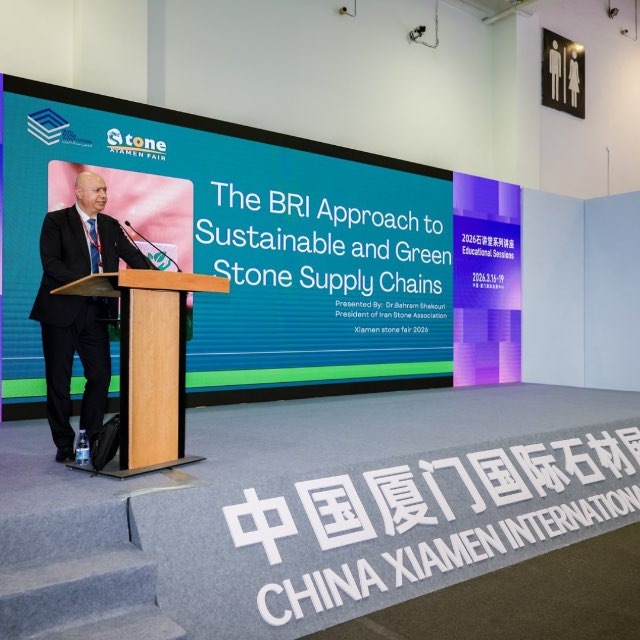
This article is based on Dr. Bahram Shakouri’s presentation at the Xiamen Stone Fair conference. In this presentation, he examined the position of the natural stone industry in the global market, the environmental advantages of this industry, and the need to redesign the stone supply chain with a green and efficient approach.
What is Xiamen Stone Fair 2026?
Xiamen Stone Fair 2026 is one of the most important international events in the stone, processing, equipment, and related materials industry in the world, held annually in Xiamen, China. This exhibition and conference is a gathering place for producers, industry activists, designers, architects, investors, and market decision-makers from various countries, providing a platform for introducing new trends, business opportunities, new technologies, and sustainable development solutions in this industry.
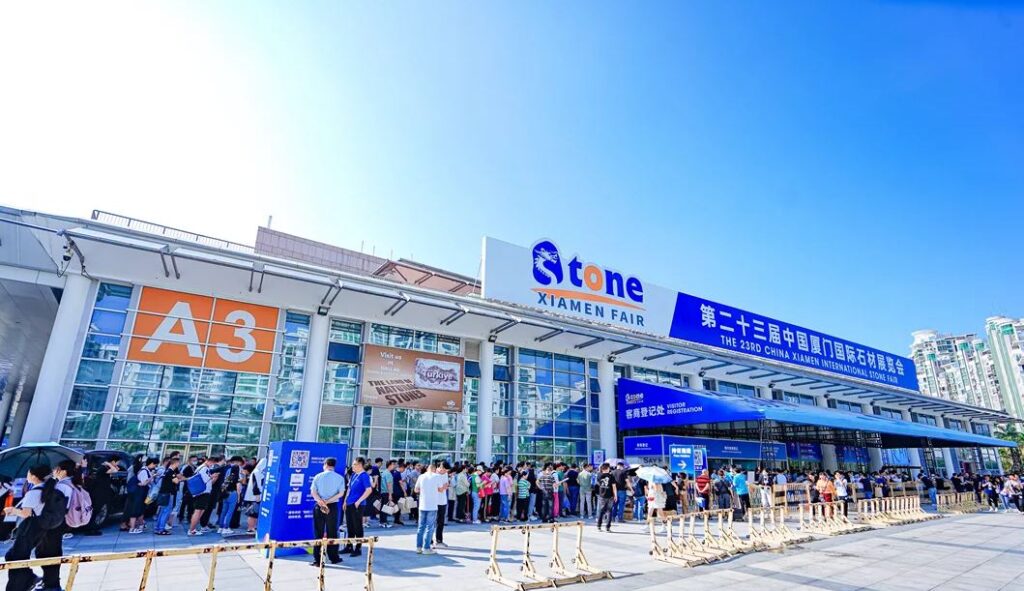
The Paradox of Growth; A Market That Is Getting Bigger But the Share of Natural Stone Is Getting Smaller
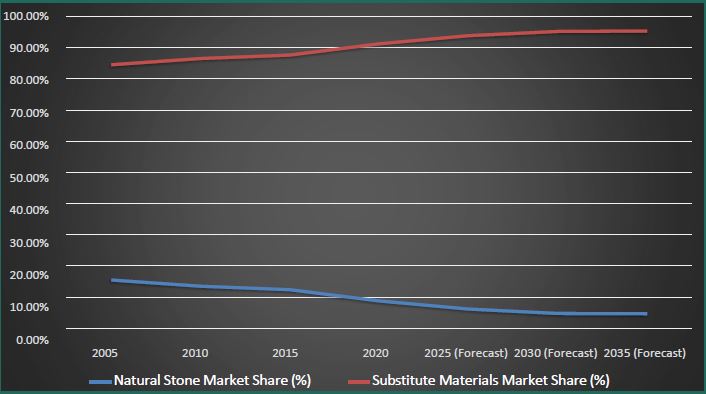
One of the key concepts discussed in the presentation is the so-called “paradox of growth”. According to the data presented, the global natural stone market is still growing, but this growth is much slower than the growth of the overall architectural materials, building surfaces, and coating materials market. This difference in growth rates leads to a decrease in the actual share of natural stone in the global market over time.
According to the statistics presented in the presentation, the value of the natural stone market has increased from $31.8 billion in 2015 to around $40.4 billion in 2024 and is expected to reach around $60.6 billion by 2035. These figures seem positive at first glance, but the important issue becomes apparent when compared to the larger market in which natural stone competes.
While the compound annual growth rate of the natural stone market is estimated to be around 3.5%, the global architectural surfaces and facade market is expanding at a rate of approximately 7.7%. This means that although the natural stone industry is growing in terms of numbers, it is losing its market share. In this presentation, it is mentioned that natural stone currently accounts for only about 4.7% of the global architectural surfaces market and that if the current trend continues, this share may fall below the 5% threshold by 2035.
This decline in market share is not just a statistical indicator; it can also be a sign of an important structural change. If this trend continues, natural stone will gradually move from being a standard and well-known luxury material to a niche product, used only in specific parts of the market rather than being widely present in architectural and construction projects.
The Environmental Advantage of Natural Stone; A Superiority That Has Not Been Properly Narrated
An important part of this presentation is dedicated to the topic of the environmental superiority of natural stone compared to many alternative materials such as ceramics and porcelain. According to the data presented, the carbon footprint of natural stone is lower than that of industrial rival materials in many cases. This is because the processing of natural stone is mainly based on mechanical energy, while the production of materials such as ceramics and porcelain requires high thermal energy consumption at very high temperatures.
In this presentation, the average carbon emission of natural stone is stated to be between 8 and 25 kilograms of CO₂ per square meter in some samples. In contrast, this figure is around 15.5 kilograms for standard ceramic tiles and around 29.9 kilograms of CO₂ per square meter for large porcelain slabs. Accordingly, in some scenarios, natural stone can be several times cleaner than some rival options.
The strategic point made in this section is that despite this real advantage, the natural stone industry has not been able to convey it well to the global market, final consumers, architects, and policymakers. In the words of the presentation, the stone industry is losing its market share to materials that are sometimes more polluting, but due to stronger narration, more effective branding, and better presence in the competitive space, they have consolidated their position.
Therefore, the issue is not just about producing cleaner; it is also about the ability to turn this advantage into a comprehensible, measurable, and trustworthy message for the market.
When the Supply Chain Eliminates the Green Advantage
Despite the inherent environmental advantages of natural stone, Dr. Shakouri’s presentation warns that the current structure of the supply chain in many cases actually neutralizes this superiority. In this section, a very explicit term is used: “carbon suicide”. This term refers to the pattern of inefficiency in which raw stone is extracted from one region, then transported to a distant hub for processing, and finally the processed product is returned to the original market or near the initial source.
In one of the real scenarios presented in the presentation, raw stone blocks are transported about 8,000 kilometers to a processing center and then, after being converted into slabs or final products, they are returned to the consumer market another 8,000 kilometers. In such conditions, although the initial production of stone may have a relatively low carbon footprint, the logistics burden imposed on the chain almost eliminates this advantage.
According to the numbers presented in the presentation, the base production, including extraction and primary processing, is about 8 kilograms of CO₂ per square meter; the carbon penalty for transporting raw blocks is about 10.9 kilograms of CO₂ per square meter; and the penalty for returning the processed slab is also about 10.9 kilograms of CO₂ per square meter. As a result, the total carbon footprint of this cycle reaches about 33.8 kilograms of CO₂ per square meter; a figure that not only eliminates the advantage of natural stone but also puts it in a weaker position than some rival materials like ceramics and porcelain.
This is the point where the issue of competitiveness is no longer just about the quality or beauty of the stone; it is also tied to the logic of the supply chain. If trade and processing routes are not redesigned, even the cleanest and most valuable materials may ultimately be losers in the market assessment.
From the Silk Road to the Value Chain; Inspiration from a Historical Logic
From the Silk Road to the Value Chain; Inspiration from a Historical Logic
Dr. Shakouri, to explain the correct path of transformation, drew inspiration from a historical metaphor: the logic of the Silk Road. In this view, the road or corridor is not just a transportation route; it is a value chain; a path where goods are gradually completed, enriched, and brought closer to the final market.
Just as in the past, raw silk was taken to dyeing, weaving, and completion centers along its path and eventually entered the market as a more valuable product, in the stone industry, the same logic should prevail. That is, transportation should not mean pointless movement of raw materials in back-and-forth routes; every kilometer traveled should be accompanied by more added value, more completion of the product, and closer proximity to the final destination.
In this framework, the philosophy of modern corridors is also redefined: the corridor is not just a communication route; it is a platform for processing, value creation, waste reduction, and alignment of production with the consumer market.
Transition from Logistical Loops to Linear and Smart Paths
One of the most important strategic proposals of the presentation is the replacement of “logistical loops” with “linear logistics”. In the current model, the stone trade has a structure similar to a dumbbell in many cases; that is, raw materials travel long distances to processing centers, lose a large part of their mass as waste, and then the final product is returned to the same region or market near the origin.
This structure is both economically inefficient and environmentally harmful. The transportation of high-weight raw materials, the transfer of hidden waste, the prolongation of delivery times, and the imposition of additional costs on the chain are the consequences of this model.
The proposed solution is a direct path from the mine to the consumer market; a model in which processing is done at points that are either close to resources or located on the natural path to the market, and at each stage, the stone becomes closer to its final and consumable form. In such a model, the goal is that:
- Every kilometer of transportation helps reduce the final cost;
- Every stage of processing brings the product closer to the final market;
- And the entire chain serves competitiveness, speed, and sustainability instead of reproducing waste.
Criteria for Forming a Strategic and Optimal Corridor
In this presentation, Dr. Shakouri introduced several key criteria for designing an optimal corridor in the stone industry. The first criterion is proximity to consumer markets; that is, the corridor should provide quick and direct access to the largest and fastest-growing markets in the construction and architecture sector.
The second criterion is the shortest route between the mine and the customer. The less unnecessary distance and movement, the lower the hidden costs of the chain.
The third criterion is green logistics; meaning that the transportation and processing structure should be designed to minimize the carbon footprint and preserve the environmental advantage of natural stone.
The fourth criterion is economic efficiency and return on investment. A successful corridor should be able to utilize local advantages, cost savings, faster delivery, and higher productivity to increase competitiveness.
And finally, synergy with global major corridors is also of great importance. Connection to international routes and major transportation infrastructure can reduce the time, cost, and risk of the chain and provide more sustainable access to markets.
Green Stone Corridor; A Solution to Reduce Cost, Carbon, and Distance from the Market Simultaneously
The strategic conclusion of Dr. Shakouri’s presentation is crystallized in the concept of the “Green Stone Corridor”; a model that can simultaneously address the three main issues of the industry: high costs, heavy carbon footprint due to incorrect logistics, and long distance from consumer markets.
According to the data presented, optimizing the current loops of movement of about 3 million tons of raw blocks per year can reduce annual emissions from about 1.98 million tons of CO₂ to about 0.48 million tons of CO₂. In other words, nearly 1.5 million tons of preventable excess emissions can be avoided.
Also, in this model, the carbon footprint can be reduced from about 33 kilograms of CO₂ per square meter to about 8 kilograms; that is, a reduction of about 75%. Alongside this environmental achievement, eliminating unnecessary routes can prevent hundreds of millions of dollars in annual logistics waste and significantly reduce the final delivery price for target markets.
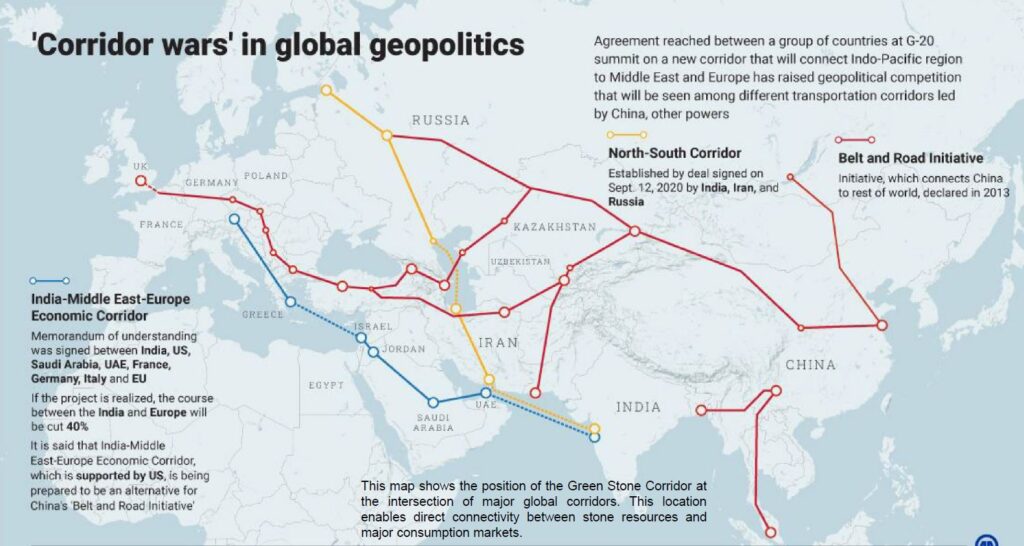
This corridor also provides the possibility of direct connection between rich stone resources in countries such as Iran, India, Turkey, Afghanistan, and Egypt and major and growing regional and trans-regional markets. In this framework, access to dozens of major markets, including construction markets in the GCC and CIS, is one of the main advantages of this approach.
Iran’s Role in This New Equation
In the final part of this presentation, Dr. Shakouri discussed Iran’s position in this new order. Iran, in terms of geographical location, access to stone resources, energy capacities, transportation infrastructure, and specialized capabilities in the stone industry, is at a point where it can play an effective role in shaping and strengthening this corridor.
In this view, Iran is not just a transit route or a passing point; it can act as an active facilitator of value creation in the chain; a role that includes optimizing logistics, supporting processing, reducing friction in the production and distribution flow, and helping to bring resources closer to consumer markets.
The ultimate goal of this approach is to align production, processing, transportation, and distribution within a coordinated and efficient system; a system that can create a more competitive, greener, and sustainable future for the global stone industry.