
This article has been prepared by Dr. Mahvi, a specialized consultant of Sigmas in the field of water.
The steel industry is responsible for 7 to 10% of the world’s CO2 emissions. For the first time, the Strategic Institute of Green Mine and Steel Institute (SIGMAS) has been established in Iran. The need to develop a Green Steel Master Plan with three short-term, medium-term, and long-term scenarios should be considered. This plan cannot be prepared without considering global technologies and events, and it includes the green steel production chain from the upstream phase, i.e., iron ore deposits, mining (quantitative and qualitative), industries (exploitation, sizing, and concentration) to production.
Developing new methods for capacity building, access to iron ore and natural gas deposits is crucial for one of the stages of the direct reduction method, but access to energy for the production of clean hydrogen is one of the challenges of this technology in the future.
In order to prepare this plan, the past and future of the steel industry, as well as Iran’s global role, are of great importance. For example, DRI production reached a record 108 million tons in 2019, showing a 7.3% increase compared to the previous year, and countries such as India, Iran, and Algeria have played a key role in this field. In this scenario, the International Energy Agency’s (IEA) predictions indicate that the share of DRI-based gas will be equivalent to 8% by 2030.
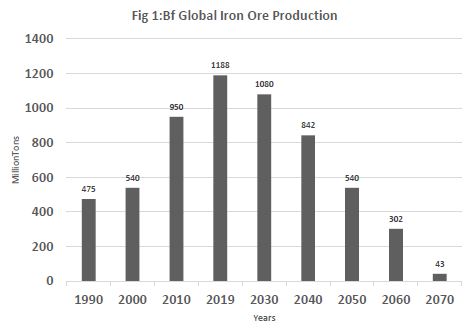
What we are witnessing today is that it is predicted that the production of steel by the BF method, even with the intervention of carbon absorption and reduction innovations, will decline in the world over time, based on the thought of more than 1 billion tons in 2019, and production by this method will decrease to 43 million tons by 2070. (Figure 1)
With the reality of climate change and global confrontation, at the COP26 conference in Glasgow, attended by 153 countries, achieving zero CO2 emissions, reducing fossil fuel consumption, eliminating coal subsidies, reducing methane emissions, and developing energy sources used in the steel industry were emphasized. Subsequently, at the COP27 conference in Sharm El-Sheikh, Egypt, decisions related to economic actions and mechanisms for global sustainable development were re-emphasized.
The steel industry faces challenges with global warming, and the following events occur in this path:
1- Reduction of integrated steel production using the blast furnace method and consumption of coke, coal, and base oxygen production, which has been shaping the steel industry in the world since 2019.
2- Increase in steel production using electric arc furnaces
3- Increase in the share of scrap in steel production
4- Increase in the use of direct reduction methods, especially hot briquetted iron (HBI) or sponge iron in steel production
Given the above, the International Energy Agency’s assessment of the green steel production trend using commercial direct reduction methods, as well as carbon capture, utilization, and storage (CCUS), and the use of 100% hydrogen production methods, is shown in Figure 2, which indicates that the latter methods have more weight.
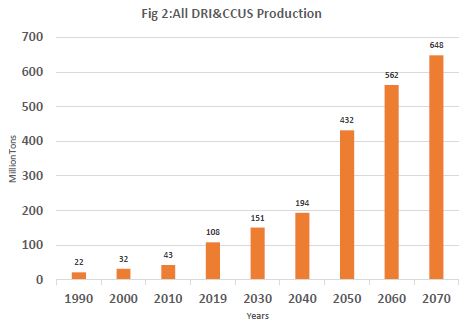
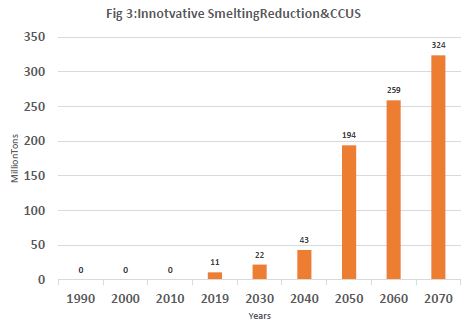
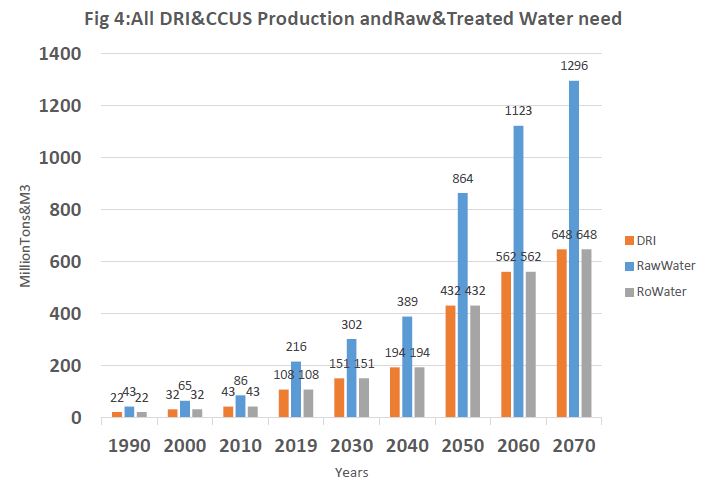
As Figure 2 shows, it is predicted that green steel production using DRI methods, commercial DRI with CCUS, and ultimately 100% H2 DRI, will increase from 22 million tons in 1990 to 648 million tons in 2070. However, according to the International Energy Agency’s (IEA) predictions, steel production using innovative smelting methods with CCUS reduction will also play a significant role, which Figure 3 shows the global development and progress of this method in the future.
Water Consumption in a Green Steel Plant
Water consumption in a green steel plant depends on the production technology, water recycling rate, inlet water quality, and product type. Therefore, there is no fixed number, but according to the World Steel Association’s reports, the HYBRIT and H2 Green Steel projects, and similar plans, the following values can be initial and suitable estimates for feasibility studies. The usual values are as follows:
Water Type
Usual consumption for producing 1 ton of crude steel: raw water intake is about 1 to 3 cubic meters
Treated/demineralized water: about 0.2 to 0.8 cubic meters
For green steel plants based on DRI + EAF that use hydrogen or natural gas and renewable electricity, the usual values are:
Raw water required: about 1.5 to 2.5 cubic meters per ton of steel
Industrial treated water required: about 0.3 to 0.6 cubic meters per ton of steel
In Case of Using Green Hydrogen
If hydrogen is produced on-site through electrolysis, water consumption increases:
For producing 1 kilogram of hydrogen, about 9 to 10 liters of pure water are consumed.
Usually, for producing 1 ton of steel with hydrogen, 50 to 70 kilograms of hydrogen are required.
Therefore, the water required for electrolysis is about 0.45 to 0.7 cubic meters per ton of steel, which should be added to the process water.
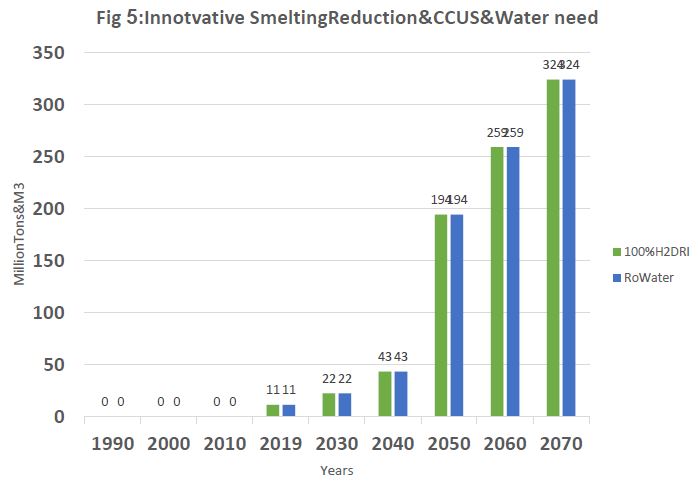
Figures 4 and 5 show the relationship between water demand and green steel production with different technologies.
Conclusion:
New green steel production technologies are rapidly and increasingly replacing indirect reduction methods worldwide, such that it is predicted that by 2070, the share of BF production will decrease to 4% from 1015 million tons, while in 2019, the share of DRI production was only 9% of 1307 million tons.
For a green steel complex with high water recycling:
Total raw water: about 1.5 to 3 cubic meters per ton of steel
Process treated water required: about 0.3 to 0.8 cubic meters per ton of steel
In case of on-site hydrogen production: about 0.5 cubic meters of additional pure water for electrolysis per ton of steel.